The paper of "Population‐scale landscape of TE insertion polymorphisms reveal their roles in gene expression regulation, adaptation, and agronomic traits in Brassica napus" has been published on Journal of Integrative Plant Biology. Congratulations!
On January 19, 2026, the Innovation Team for Oilseed Crop Genomics and Disease‑Resistance Improvement at the Institute of Oilseed Crops Research, Chinese Academy of Agricultural Sciences, published an online research paper entitled Population‑scale landscape of TE insertion polymorphisms reveal their roles in gene expression regulation, adaptation, and agronomic traits in Brassica napus in Journal of Integrative Plant Biology (JIPB) (https://doi.org/10.1111/jipb.70120). This study systematically dissected the distribution characteristics of TE insertion polymorphisms (TIPs) in Brassica napus populations, and further uncovered their critical roles in gene expression regulation, ecological adaptive differentiation, and the formation of key agronomic traits.
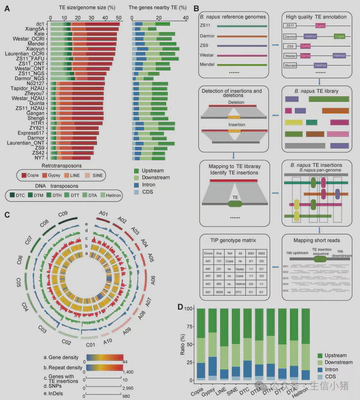
The research team integrated whole‑genome resequencing, transcriptomic, and agronomic trait datasets from 381 Brassica napus germplasm accessions, constructed a pan‑transposon library based on 28 distinct reference genomes, and identified 77 603 TIP loci. The study revealed that most TE insertions are non‑essential and exhibit weak linkage with neighbouring SNPs, suggesting that they may represent recent or ecotype‑specific variants that independently contribute to regulatory and adaptive diversity in Brassica napus.
Using two complementary strategies, direct impact analysis and TIP‑based eQTL mapping, the study validated that TEs can modulate gene expression via cis‑acting and long‑range trans‑acting effects. Notably, TE‑mediated trans‑regulation, which has received limited attention in previous studies, is prevalent and displays pronounced tissue‑specificity. Selective sweep analysis further identified ecotype‑specific TIPs associated with adaptive differentiation, which exert particularly important functions in the divergence of semi‑winter ecotypes.
TIP‑based genome‑wide association study (GWAS) detected 1 102 TE insertions significantly associated with pivotal traits including flowering time, fatty‑acid composition and glucosinolate content; some of these loci escaped detection by conventional SNP‑based GWAS. This research not only generates a population‑scale map of TE insertions in Brassica napus and illustrates their extensive regulatory functions, but also provides valuable resources for crop breeding and functional genomics research.
Full text article link: https://pubmed.ncbi.nlm.nih.gov/41552871/